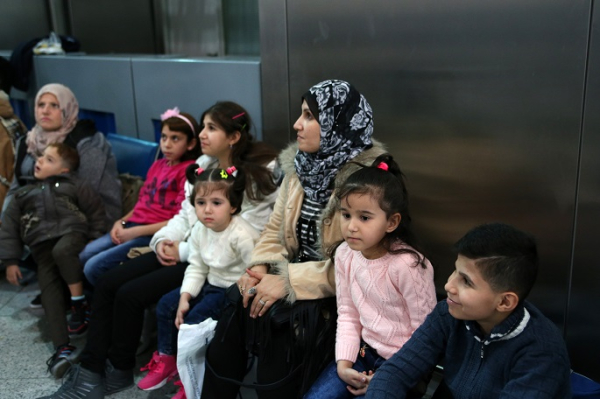


Escalating tensions in the Middle East following recent military confrontations are raising concerns across Europe about the risk of a new refugee crisis, reported Xinhua.
On Tuesday, the International Organization for Migration (IOM), the United Nations migration agency, said that more than 130,000 people have crossed into Syria and over one million people have been displaced inside Lebanon since early March.
Although large-scale migration toward Europe has not yet materialized, the agency warned that conditions for broader displacement already exist in a region long affected by conflict.
"There are no signs" of an imminent surge of refugees to Europe, but "things can change very quickly," Sweden's Migration Minister Johan Forssell told Euronews earlier this month.
Cyprus's Deputy Migration Minister Nicholas Ioannides warned on March 13 that the European Union "cannot overlook the possibility of a new refugee crisis."
EU leaders have also stressed vigilance, though the conflict "has not translated into immediate migratory flows towards the EU," according to conclusions adopted after a European Council meeting.
Drawing on lessons from the 2015 migration crisis, when more than 1 million refugees and migrants entered Europe, the EU has pledged to strengthen external border controls and mobilize diplomatic, legal, operational, and financial tools to manage potential migration pressures.
"The security and the control of the EU's external borders will continue to be strengthened," the bloc said last Thursday.
The EU is also preparing to implement its Migration and Asylum Pact in June. The pact introduces stricter border procedures and a "mandatory solidarity" mechanism under which member states will share responsibility by relocating asylum seekers or providing financial and operational support to countries under strain.
Memories of the 2015 migration crisis continue to shape policy thinking. The influx overwhelmed border and asylum systems, triggering political divisions within the bloc.
Nedzad Korajlic, an associate professor at the University of Sarajevo, said Bosnia and Herzegovina faces challenges as a transit country, including limited border control capacity and fragmented security structures. He said the main issue is not migration itself but criminal networks that exploit migrants through smuggling.
Europol, the European Union's law enforcement agency, has rung the alarm. "Migrant smuggling networks are operating with increasing complexity, both online and offline," Europol Executive Director Catherine De Bolle said Tuesday in The Hague. "They have a significant global dimension and rely on multi-layered financial infrastructures, including underground banking systems, to move and conceal their criminal profits."
Europol launched the European Center Against Migrant Smuggling on Tuesday in The Hague to enhance intelligence-sharing and operational coordination across member states.
"With the establishment of the European Center Against Migrant Smuggling, Europol is now stepping up its efforts, enhancing its capacity to support member states and reinforcing the collective response to this complex and evolving threat," De Bolle said.
Korajlic said Europe is better prepared than in the past despite ongoing risks. The creation of the center marks "a shift from reactive to preventive measures," with a stronger focus on intelligence-sharing and coordinated action, he added.
- Middle East
- War
- Refugee
- Europe
Source: www.dailyfinland.fi
