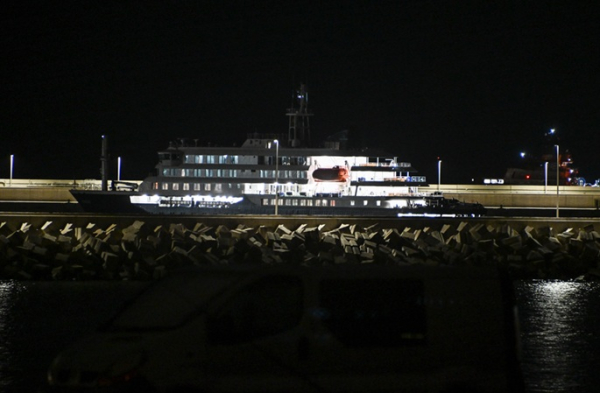


One of the 14 Spanish evacuees from the hantavirus-hit cruise ship MV Hondius on Sunday has tested preliminarily positive for the virus, Spanish Health Minister Monica Garcia said Monday, reported Xinhua.
Garcia wrote on X that one of the Spanish passengers currently under isolation at Madrid's Gomez Ulla hospital had tested preliminarily positive in a PCR test conducted upon arrival.
"The person remains in isolation, without symptoms and in general good health, under continued clinical observation in accordance with established safety and epidemiological protocols," she wrote.
The other 13 Spaniards tested provisionally negative, while final results were expected in the coming hours, the minister said.
According to health authorities and the World Health Organization (WHO), the outbreak is believed to involve the Andes strain of hantavirus, a variant known for possible person-to-person transmission through close contact. The virus is typically transmitted through exposure to infected rodent urine or droppings.
The Spanish evacuees were transferred to Madrid as part of an evacuation operation launched after the MV Hondius arrived in Spain's Canary Islands over the weekend.
Multiple confirmed and suspected cases have so far been linked to the outbreak, including passengers transferred to several countries for treatment and monitoring.
The final group of evacuees left the ship on Monday after the vessel briefly docked at the Port of Granadilla on the Spanish island of Tenerife due to adverse weather conditions. The ship later departed for Rotterdam in the Netherlands.
Meanwhile, seven cases of the Andes virus hantavirus infections have been confirmed among people on board the cruise ship MV Hondius, the World Health Organization (WHO) said on Monday.
The overall tally of symptomatic cases has reached nine, after a French passenger evacuated from the MV Hondius on Sunday had tested positive for the virus, Olivier Le Polain, head of the Epidemiology & Analytics for Response (EAR) of the WHO, said in a live social media conversation held in Geneva.
The WHO announced on Saturday that as of May 8, eight symptomatic cases of the virus have been reported, including three deaths.
Andes virus is a rodent-borne hantavirus endemic to South America and the only known hantavirus capable of limited human-to-human transmission.
Meanwhile, the European Commission said Monday that it is coordinating and supporting national authorities' response to a hantavirus outbreak, while the European Centre for Disease Prevention and Control (ECDC) assesses the risk to the general population in Europe as very low.
Since Spain activated the EU Civil Protection Mechanism on May 6, the EU's Emergency Response Coordination Centre has been facilitating the safe evacuation of people aboard the MV Hondius cruise ship, which was anchored off Tenerife.
Five repatriation flights coordinated by the EU took place on Sunday and were carried out by France, Spain, the Netherlands, Greece and Ireland. A sixth and final flight, operated by the Netherlands, departed on Monday, according to the Commission.
The EU is also mobilizing response capabilities and stockpiles from its strategic reserve. A medical evacuation aircraft from the EU fleet, hosted by Norway, has been pre-positioned in Tenerife, while additional transport and logistics capacities, as well as protective equipment, are ready to be deployed if needed.
The Emergency Response Coordination Centre has deployed a liaison officer to Tenerife to support on-site coordination with relevant authorities. The ECDC also deployed two experts from the EU Health Task Force to the ship before passengers disembarked.
According to the Commission, the EU is working closely with EU members, countries participating in the Civil Protection Mechanism, the ECDC, the World Health Organization and G7 partners in responding to the outbreak.
Commissioner for Equality, Preparedness and Crisis Management Hadja Lahbib said health threats can easily cross borders and coordination is therefore essential.
- Hantavirus
- MV Hondius
Source: www.dailyfinland.fi
