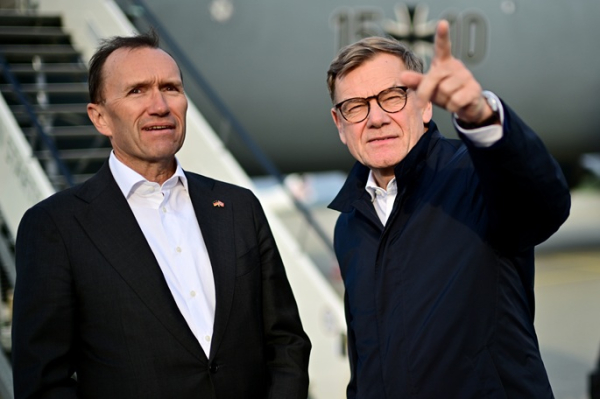


German Foreign Minister Johann Wadephul called on Tuesday for stronger deterrence and defence efforts on NATO's northern flank in view of increasing hybrid threats from Russia.
"Russia is continuing to expand its military presence here in the Arctic too and is trying to secure its influence in the region," Wadephul warned at a meeting with his Norwegian counterpart Espen Barth Eide in the city of Bodø, north of the Arctic Circle.
Russia has capabilities in the so-called High North and the Arctic "that we have to take seriously, also with a view to our security in Central Europe," Wadephul said.
Norway plays a key role as NATO's "early-warning sonar and radar in the North Atlantic," he said.
The region is "the main artery of our security and our prosperity" with undersea cables and infrastructure as well as sea and air routes that are essential for supplying Germany and Europe.
That was why the High North must "remain a space of stability and cooperation," he said.
China too, he said, is stepping up its engagement in the Arctic and is present through investments in strategic infrastructure and research activities.
Integrated headquarters of the Norwegian armed forces
Wadephul and Eide visited the headquarters of the Norwegian armed forces in Reitan, east of Bodø.
In the integrated command centre deep inside a mountain, around 300 people plan, coordinate and conduct military operations as well as national or multinational exercises such as those of NATO in close coordination with civilian authorities including police, rescue services or the weather service.
In the situation centre, Russia's increasing military activities with aircraft and submarines in the Arctic or in the Norwegian Sea are monitored by satellite, radar systems or surveillance aircraft.
The two ministers then travelled by speedboat to the Arctic research institute at Nord University in Bodø.
It is regarded as one of Norway's most important centres of expertise on issues relating to the Arctic and the High North. Founded in 2007, the institute deals with geopolitical, economic and social developments in the region and works closely with companies and public-sector institutions.
The two politicians also plan to visit the NATO air operations centre in Bodø, which opened in October as counterparts to existing centres in Germany and Spain.
- Russian threat
- Arctic security
Source: www.dailyfinland.fi
