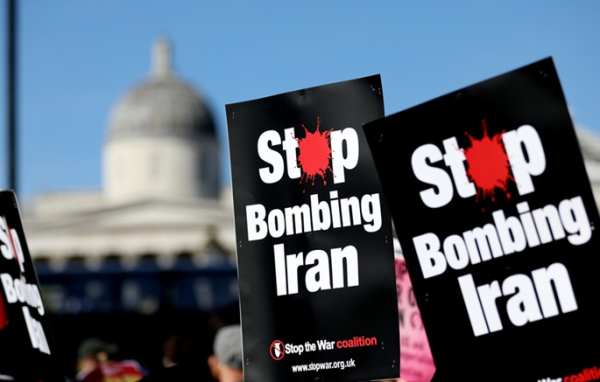


Protesters rallied in London on Saturday against U.S.-Israeli strikes on Iran, an escalation that has heightened tensions in the Middle East and driven up global energy prices, reported CCTV+.
Chanting slogans and carrying banners reading "Stop bombing Iran", demonstrators urged the international community to press for a ceasefire and peaceful negotiations.
"We, the good people, are just getting used to sitting there and watching on our TVs, doing nothing, and not stopping it. And then Iran, and watching those people being slaughtered. Where are we going to end up? We've got to act; the time is urgent," said a protester.
A day before the rally, the British government approved U.S. use of its bases for operations aimed at degrading missile sites and capabilities used to attack ships in the Strait of Hormuz, a chokepoint for one-fifth of the world's oil. The move has stirred controversy at home, with many protesters warning it would draw the UK deeper into the conflict and increase security risks.
"I think it's really important that we're on the streets. I also think one of our demands, which is that Britain doesn't allow the use of our bases for American strikes, is also very important," said a protester.
"Our membership of NATO drags us into the war, which the majority of British people oppose. Every poll shows that as to the majority of American people, as to obviously all the people to the Middle East, you know, so it's a deeply unpopular war of aggression," said another protester.
As the war drags on, large anti-war rallies have spread across the UK with the public expressing growing concern over the conflict’s escalation.
Meanwhile, Large-scale protests erupted in Berlin, Germany on Saturday, as demonstrators condemned U.S. and Israeli military strikes on Iran and called for dialogue and diplomacy to resolve conflicts.
Crowds gathered in central Berlin, with people from across Germany, social groups, and peace organizations taking to the streets. Waving banners and chanting slogans, protesters voiced strong opposition to recent U.S. and Israeli military actions against Iran.
"This is clearly a war of aggression. Iran has done nothing and has never expressed any intention to attack Israel or the United States. There is no justification for war, so this is an unprovoked act of aggression. According to international law, this is a war of aggression and a violation of international law," said one protester.
"They are not playing by the rules, just as they did during the Iraq war. The United States has long violated international law, and in recent years, this has only gotten worse. The latest examples clearly show this is a blatant violation of international law," said another protester.
Energy concerns were also a major focus of the demonstration. Analysts said that with heightened tensions in the Middle East, energy market volatility has increased, and Europe's dependence on U.S. energy has become more pronounced.
"Germany is particularly affected by energy issues. We have already reduced imports of natural gas and oil from Russia as much as possible, and imports from the Middle East are no longer feasible. In reality, only the U.S. and Norway remain as suppliers. The U.S. can easily use this as leverage against Germany, for example, by saying, 'If you don't join efforts to secure the Strait of Hormuz, we can reduce LNG and oil exports to Germany and even all of Europe.' I am concerned this could happen," said Michael Lueders, prominent Middle East scholar.
Meanwhile, in Spain, thousands gathered in Madrid, with authorities estimating around 4,000 participants. Marchers moved from Atocha to Puerta del Sol, carrying signs such as "No to war, no to NATO" and "Spain is not the U.S." Leaders from the Podemos party, including Secretary General Ione Belarra and political secretary Irene Montero, joined the rally, reported Xinhua.
Montero called on Spain to withdraw from NATO, highlighting wider criticism of Western military policy in the region.
Elsewhere, protests were reported in multiple European cities. In Lisbon, several hundred people gathered in the rain on March 14 near the U.S. embassy in a demonstration organized by the Portuguese Council for Peace and Cooperation. Backed by more than 70 groups, participants denounced what they described as U.S. and Israeli aggression, chanting "Yes to peace, no to war" and calling for disarmament.
In Bulgaria, hundreds marched in Sofia on March 2, holding signs such as "No war against Iran" and "U.S. military aircraft are not welcome here." Protesters called for an end to the strikes and demanded the withdrawal of U.S. military aircraft from Bulgarian territory.
Similar demonstrations have also taken place in countries including France and Greece, as the conflict entered its third week.
Amid the public backlash, criticism has also emerged from European analysts. Rob de Wijk, a professor at Leiden University in the Netherlands, described the U.S. actions as "outright blackmail" and warned they could pose risks to European security. He argued that Europe should reduce its reliance on the United States and strengthen its strategic autonomy.
- Protests
- US-Israeli
- War
- Iran
- London
- Berlin
Source: www.dailyfinland.fi
